Integrated Appliances: Are They Worth It In A New Kitchen?
Choosing appliances is an important part of the process of planning a new kitchen, but it’s not just the actual appliance that you choose, but how it sits in the kitchen too. How it engages with the cabinetry can greatly affect how the finished kitchen looks, feels, and functions.
Integrated appliances are designed to sit within kitchen cabinetry, using doors or panels that match the surrounding units so the appliance is less visible. This creates a more cohesive kitchen design, keeping the cabinetry and finishes as the focus.
Integrated appliances are a great choice, but not automatically the right choice for every kitchen. They can affect your project cost, how the appliances are replaced, and even the amount of usable storage space inside, so we wanted to take an honest look today at whether integrated appliances in a kitchen are worth it.
A Quick Summary
Consider integrated appliances carefully at the start of the planning process, alongside everything else. They can really improve a kitchen’s visual impact, but you should also consider repairs and replacements when deciding whether freestanding is a better option for you.
What Are Integrated Kitchen Appliances?
An integrated appliance is fitted into the kitchen cabinetry rather than standing separately from it. For example, a dishwasher can sit behind a matching cabinet door, while an integrated fridge freezer is concealed within a run of cabinetry.
You will also see the terms integrated and built-in used when discussing kitchen appliances. They are closely related, but not always interchangeable. An integrated appliance is generally designed to be concealed behind a cabinet front. In contrast, built-in appliances such as ovens and microwaves are fitted into a cabinet or housing but remain visible.
The key point is that you need to consider the appliance and the cabinetry together. Each appliance has its own dimensions and installation requirements, and the cabinetry must accommodate them properly.
Some examples of items that could be integrated or built-in are:
- Oven
- Microwave
- Dishwasher
- Washing Machine
- Tumble Drier
- Fridge Freezers
- Coffee Machines
Why Choose Integrated Appliances?
The main reason for choosing integrated appliances is often visual. When appliances sit behind matching cabinetry, the kitchen can feel more like one considered design rather than a collection of individual appliances, but let’s explore some other reasons:
- Create a More Cohesive Appearance
A freestanding fridge, dishwasher or washing machine can become a prominent feature within a kitchen. Concealing it behind a cabinet front lets the cabinetry run across the room without interruption.
This can be particularly effective where you have chosen a detailed or characterful kitchen design and do not want large metallic appliances to compete with it.
- Keep Sightlines Clear
Integrated appliances can help to reduce the visual contrast between different parts of the kitchen. Rather than drawing the eye towards a stainless steel appliance or a large freestanding fridge freezer, the cabinetry provides a more continuous line.
This can be useful in open-plan kitchens, where the kitchen is viewed from the dining or living area as well as from the cooking space.
- Support a Particular Design Style
The choice of appliances can form part of the wider kitchen style. In a traditional kitchen, for example, concealing modern appliances can help maintain the appearance of a run of cabinetry. In a contemporary kitchen, integrated appliances can create the clean, streamlined finish that often works well with simpler cabinetry.
Hamilton Stone Design’s contemporary kitchens demonstrate how appliances and technology can be incorporated into the wider design rather than treated as separate features. Integrated appliances can be particularly effective when the aim is to create a kitchen where the cabinetry remains the dominant visual element.
- Make Appliances Part of the Cabinetry
Integration allows the appliance to become part of the kitchen furniture. A dishwasher can disappear beneath a cabinet front, while a fridge freezer can be incorporated into a full-height run.
This can be useful when planning a kitchen around symmetry, proportions or a particular cabinetry layout. Instead of working around the appearance of a freestanding appliance, the appliance becomes part of the overall design.
- Work Well in Open-Plan Kitchens
In an open-plan kitchen, appliances are visible from much further away. You may see the fridge or dishwasher from the dining table or sofa, rather than only from the cooking area.
Integrated appliances can help the kitchen feel more connected to the rest of the room by reducing visible technology.
- Keep Technology From Dominating the Room
Modern kitchens can contain a surprising amount of technology. Ovens, microwaves, coffee machines, refrigeration, dishwashers, extraction and smaller appliances all need somewhere to go.
Integrating some of these appliances lets the technology work quietly in the background while the materials, cabinetry, and overall design remain the focus.
When Might Freestanding Be the Better Choice?
If flexibility is your priority, integrated appliances are not necessarily the best choice, but freestanding could be.
Freestanding appliances are easier to replace and may offer a wider choice of styles, dimensions, and capacities. This can be particularly useful if you want a large fridge freezer or have a particular statement piece in mind.
You don’t have to choose between a fully integrated kitchen and one filled with freestanding appliances. Combining the two can sometimes produce the most practical result.
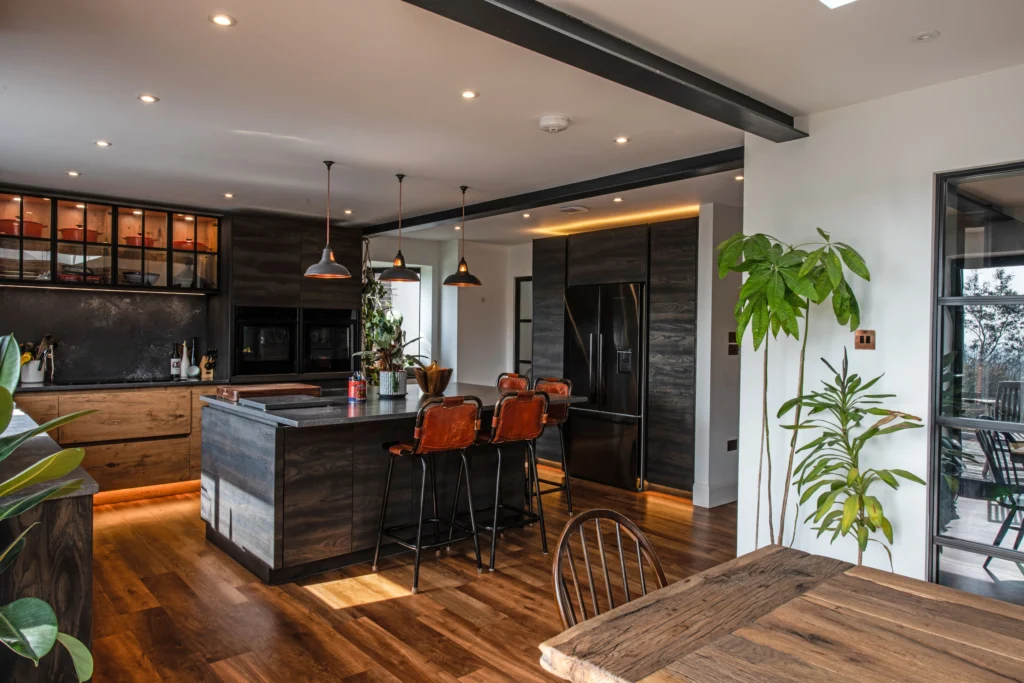
Not Every Appliance Needs to Be Hidden
Not every appliance in a kitchen needs to be integrated.
A particular range cooker, statement fridge freezer or other appliance may be something you want to see. Smaller appliances might be better kept accessible, while others can be concealed within cabinetry when not in use.
The aim is not to hide everything. It is to decide which elements should form part of the visual design and which are better kept discreet.
Do Integrated Appliances Save Space?
Integrated appliances can make a kitchen feel more streamlined, but they do not create extra physical space.
The cabinetry still needs to accommodate the appliance, and the required housing can take up much the same footprint as the appliance itself. An integrated dishwasher does not suddenly give you an additional cupboard.
Integration can make the available space feel more orderly. Continuous cabinet fronts can reduce visual clutter, particularly where several appliances would usually sit alongside one another.
If the concern is countertop space, then integrating some appliances such as the microwave would free up some available room if you had the cupboard space to spare.
What Happens When You Need to Replace an Integrated Appliance?
It is easy to think about the appliance you are buying now and forget that it will eventually need replacing.
With an integrated appliance, keep a record of the model, dimensions and installation requirements. When the time comes to replace it, you can check that a new appliance will fit the existing housing and work with the cabinet door or panel.
This is particularly important with integrated fridge freezers, where dimensions and internal configurations can vary.
Are Integrated Appliances Worth It?
Integrated appliances can be worth considering if you want a kitchen with clear sightlines, cohesive cabinetry and a considered overall appearance. They can be particularly effective in open-plan rooms or where you want the kitchen to feel more like part of the wider living space.
But integration should not be treated as a rule. The right appliance needs to suit how you cook, store food, entertain, and use the room, as well as the design you want to achieve.
At Hamilton Stone Design, appliances form part of the wider kitchen design alongside the layout, cabinetry and finishes. The aim is to create a kitchen where every element has a purpose and works together, rather than choosing integrated appliances simply because they are expected in a new kitchen.
If you are planning a new kitchen and are unsure whether integrated, built-in or freestanding appliances would work best for your home, visit our showroom to explore the options and discuss how they could work within your design.
Frequently Asked Questions About Integrated Appliances
Are integrated appliances better than freestanding appliances?
Neither option is automatically better. Integrated appliances can create a more cohesive kitchen design and keep technology less visible, while freestanding appliances can offer greater flexibility for replacement, dimensions, and style. The right choice depends on the kitchen and how you use it.
Do integrated appliances make a kitchen look bigger?
Integrated appliances do not create additional physical space, but they can make a kitchen feel more streamlined. Continuous cabinetry and fewer visible appliances can reduce visual clutter and create clearer sightlines, which can be particularly useful in smaller or open-plan kitchens.
Can you replace an integrated appliance?
Yes, but make sure the replacement appliance is compatible with the existing housing and cabinet door or panel. Keeping a record of the original appliance’s model and dimensions can make future replacement easier.
Can all kitchen appliances be integrated?
Many common kitchen appliances can be integrated or built in, including dishwashers, fridge freezers, ovens and microwaves. However, not every appliance needs to be hidden. A statement range cooker or freestanding fridge freezer, for example, can become part of the overall kitchen design.
Are integrated appliances more expensive?
The cost depends on the appliance and the overall kitchen specification. You may also need to consider the cabinetry, matching doors or panels, and installation. This means you should consider the total cost rather than comparing appliance prices alone.
Do integrated appliances give you more storage space?
Not necessarily. An integrated appliance still requires space within the kitchen cabinetry, so it does not automatically create additional storage. However, integrating appliances can make the available space feel more organised and, in some cases, can free up worktop space.